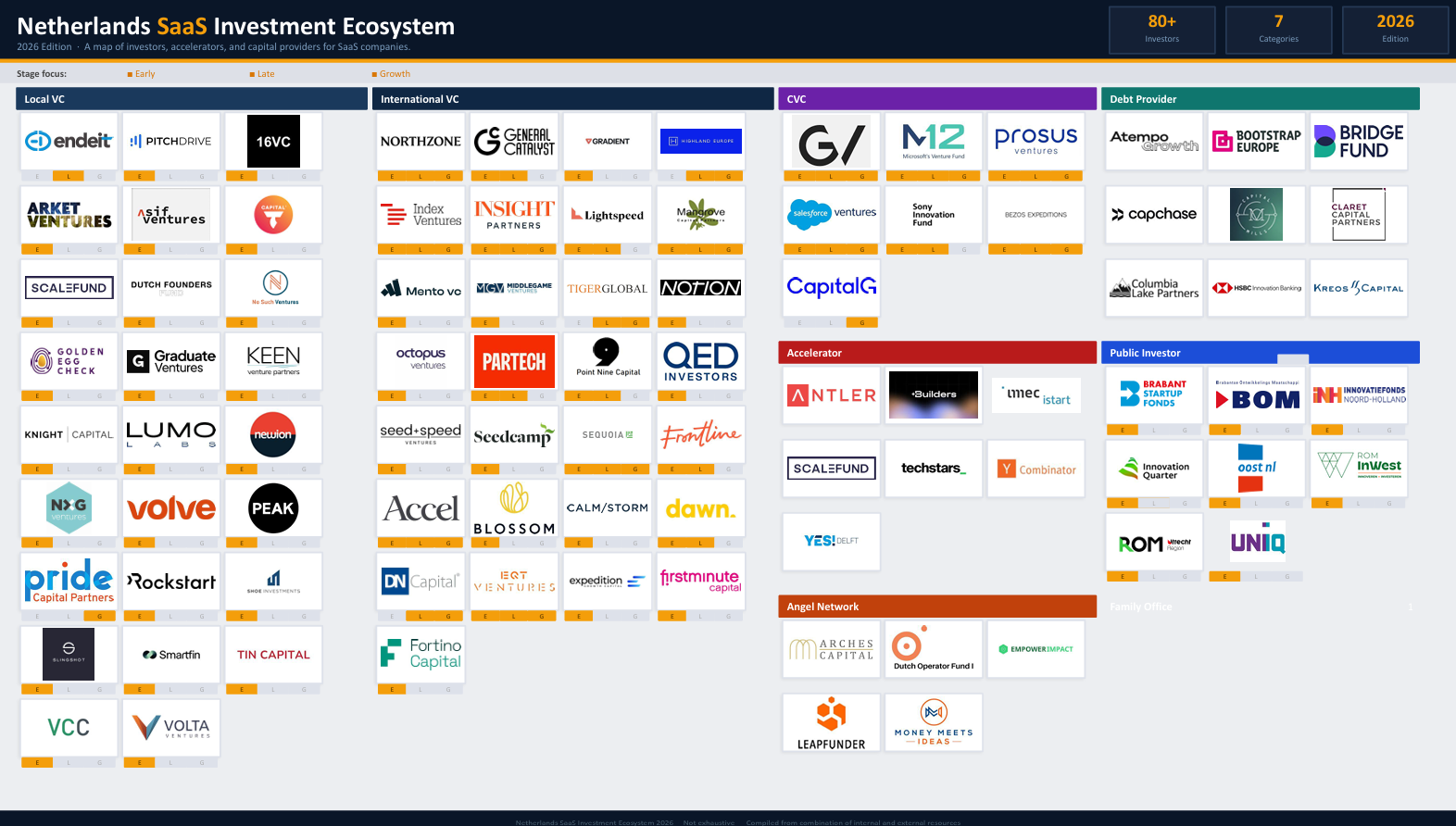
There are more than 80 active investors in the Dutch SaaS ecosystem: local VCs, international funds, corporate ventures, debt providers, accelerators, public investors, and angel networks. That sounds like a lot of choice, and it is. But for most founders, the abundance of options is more of a problem than an advantage.
What we see time and time again: founders wasting months in discussions with parties who ultimately don’t invest. Because the match simply isn’t there: wrong stage, wrong mandate, or the wrong sector. Understanding the landscape prevents that waste. This article explains the seven categories: when you need which type, and what each type of investor expects from you.
1. Public investors, accelerators, and angel networks: the earliest stage
Three subcategories, each playing a different role.
Public investors such as ROM InWest, Innovation Quarter, BOM, Oost NL, Brabant Startup Fund, and UNIQ are regional organizations that often co-invest alongside a private lead investor. They are more accessible than commercial VCs, sometimes have lower financial thresholds, and can serve as an initial validation step. The downside: funding opportunities are limited, and the process is more bureaucratic.
Accelerators such as Antler, Techstars, YES!Delft, Y Combinator, and imec.istart offer not only capital but also a program: mentorship, networking, a structured approach to early-stage product development, and a demo day as a launch platform. Suitable for pre-Seed and early Seed stages, if you’re looking for guidance and a community in addition to funding.
Angel networks such as Leapfunder, Arches Capital, Dutch Operator Fund I, and Money Meets Ideas consist of experienced founders and operators who invest early on. They’re fast, flexible, and often contribute more than just capital. An angel with industry experience can open doors that remain closed to a fund.
When to seek them out
- Before your first formal funding round.
- As a supplement to an early seed program.
2. Local VCs: the heart of the SaaS investor ecosystem
Local VCs make up the largest category on the map. Endeit Capital, Volta Ventures, Peak Capital, Newion, Tin Capital, Arket Ventures, Lumo Labs, Rockstart, Pitchdrive, and a dozen other firms fall into this category. They know the Dutch market inside and out, have networks within the local startup community, and are accustomed to working with founders raising external funding for the first time.
Local VCs are active from the Early to Growth stages, but most capital goes to Seed and Series A rounds. Investment amounts are smaller than those of international funds. Investment mandates vary by fund: Newion focuses on B2B SaaS, Smartfin on fintech, and Rockstart has sector-specific programs for areas such as Digital Health.
What they all look for: a strong team, early traction, and market potential that justifies the investment. In the earliest stages, the quality of the team carries the most weight. As your company progresses, metrics become increasingly decisive.
When to seek them out
- During your first external funding round.
- If you’re looking for local roots and active mentorship in addition to capital.
3. International VCs: larger investment amounts, higher bar
Northzone, General Catalyst, Lightspeed, Insight Partners, QED Investors, Point Nine Capital, Accel, Dawn, Sequoia, and Frontline Capital operate from offices in London, Berlin, Stockholm, or San Francisco but actively invest in Dutch companies. The investment amounts are larger, the criteria stricter, and the expectations internationally focused.
International funds expect a proven product-market fit. Not just a sense that it exists, but demonstrable PMF.
That means: low churn, strong NRR (net revenue retention), a sound CAC/LTV ratio, and a business model that’s scalable beyond the Netherlands. A market of 18 million people is not an attractive final destination for most international VCs.
Access almost always comes through a warm introduction. A local VC that’s already on your cap table significantly increases your chances of having a serious conversation with an international fund. Without that bridge, it takes longer.
When to seek them out
- Series A and beyond.
- If you have proven traction and want to scale internationally.
4. Corporate Venture Capital: strategic value beyond capital
M12 (Microsoft), Google Ventures, CapitalG (also Google), Salesforce Ventures, and Prosus Ventures are the best-known names in this category. They invest on behalf of a parent company with its own strategic agenda. Return on investment is a goal, but not the only one.
That distinction is crucial. A CVC doesn’t invest purely because you promise a good financial return. They invest because you fit into their product portfolio, distribution strategy, or technology roadmap. That can be incredibly valuable: access to customers, partnerships, integrations, or an ecosystem that you’d never be able to build on your own so quickly.
The downside: decision-making is slower than with a traditional VC, and you’re entering into a relationship with the parent company. If that relationship is strong, it accelerates your growth. If the parent company’s strategic priorities change, it can also be paralyzing.
When to seek them out
- When your strategic market position is at least as valuable as the capital itself.
- And if you take due diligence on the strategic fit just as seriously as the financial due diligence.
5. Debt providers: financing growth without diluting your cap table
Bootstrap Europe, Bridge Fund, Atempo Growth, Capchase, Columbia Lake Partners, HSBC Innovation Banking, and Kreos Capital offer growth capital in the form of loans. You don’t give up any equity, but you pay interest and make repayments.
For SaaS companies with predictable recurring revenue, this is an attractive option. Especially if you’ve just closed an equity round and want to extend your runway without immediately diluting your equity again.
Or if you want to finance a specific investment, such as a major commercial contract, a go-to-market expansion, or additional headcount. Without having to open a new equity round.
The criteria differ from those for equity. Debt providers look at your ARR, your MRR growth, your churn rate, and your cash flow position. They want assurance that you can repay the loan. The threshold varies by provider, but with most lenders, you’ll need at least 1 to 2 million euros in ARR to enter into serious discussions.
When to seek them out
- Series A and beyond.
- As a supplement to equity or as a bridge between two funding rounds.
- Not as a replacement for equity in the early stages.
How Dutch SaaS investors relate to one another
The seven categories are not alternatives to one another. They follow one another in a logical sequence that most successful growing companies go through.
- Pre-Seed: angels, accelerators, public co-investors. You have an idea or an early MVP, but little proof of concept yet.
- Seed: local VCs as lead investors, sometimes supplemented by CVCs if there’s a strategic fit. You’ve gained initial traction and want to continue developing.
- Series A: local VCs remain involved; international VCs come into the picture as lead investors. You’ve proven PMF and want to scale.
- Series B and beyond: international VCs, CVCs for strategic positioning, and debt alongside equity to protect the cap table.
Each round builds on the previous one. A local VC leading your Seed round serves as a reference for an international fund during your Series A. That fund opens doors to a CVC or a larger debt facility. The reputation and network of your shareholders factor into every subsequent conversation.
The right order for approaching SaaS investors is a strategy in and of itself
Approaching the market broadly may seem efficient, but in practice, it rarely is. Founders who approach ten investors at once without clear criteria receive ten different signals and waste months on iterative discussions.
Knowing which type of investor suits your stage, what they expect, and how you can meet those expectations is work that must be completed before your first pitch. It shortens the fundraising process, improves the outcome, and fosters a healthier partnership after the round.
We help founders do that math, not just when the funding round is approaching. But well in advance.
Looking for financial advice for your tech company?
Want to know what financing options are available for your company? F.INSTITUTE helps tech companies with the financial and operational preparation for an acquisition, from the initial analysis to the data room. Please contact us. We’d love to brainstorm with you.