Most tech companies don't get their finance stack right the first time. Not because they always choose the wrong tools, but because the stack isn't designed to grow with the company.
Some examples:
- Setups cobbled together from spreadsheets and manual work.
- Financial processes that depend on a single person.
- The tech stack is not built to scale.
At some point, friction arises, especially ith more transactions, more customers, more reporting requirements, and more people working with the numbers. Until it becomes clear: this setup no longer scales.
This is a pattern we see across the board in high-tech ventures. The symptoms look different depending on the company, but the root cause is usually the same. The finance stack was built for today, not for what comes next.
Think modular, not all-in-one
You don't build a finance stack all at once. You let it evolve by adding the right layers at the right time.
The goal is straightforward. A single source of truth, as little manual work as possible, systems that integrate well, and processes that aren't dependent on one individual knowing where everything lives.
What doesn't work is going in either direction too fast. Implementing a complex ERP system before you have the volume to justify it creates overhead without benefit. Staying in spreadsheets too long creates fragility, one person leaves and the entire financial process has to be reconstructed.
The modular approach keeps you in control of that balance.
5 Most important layers in your finance tech stack
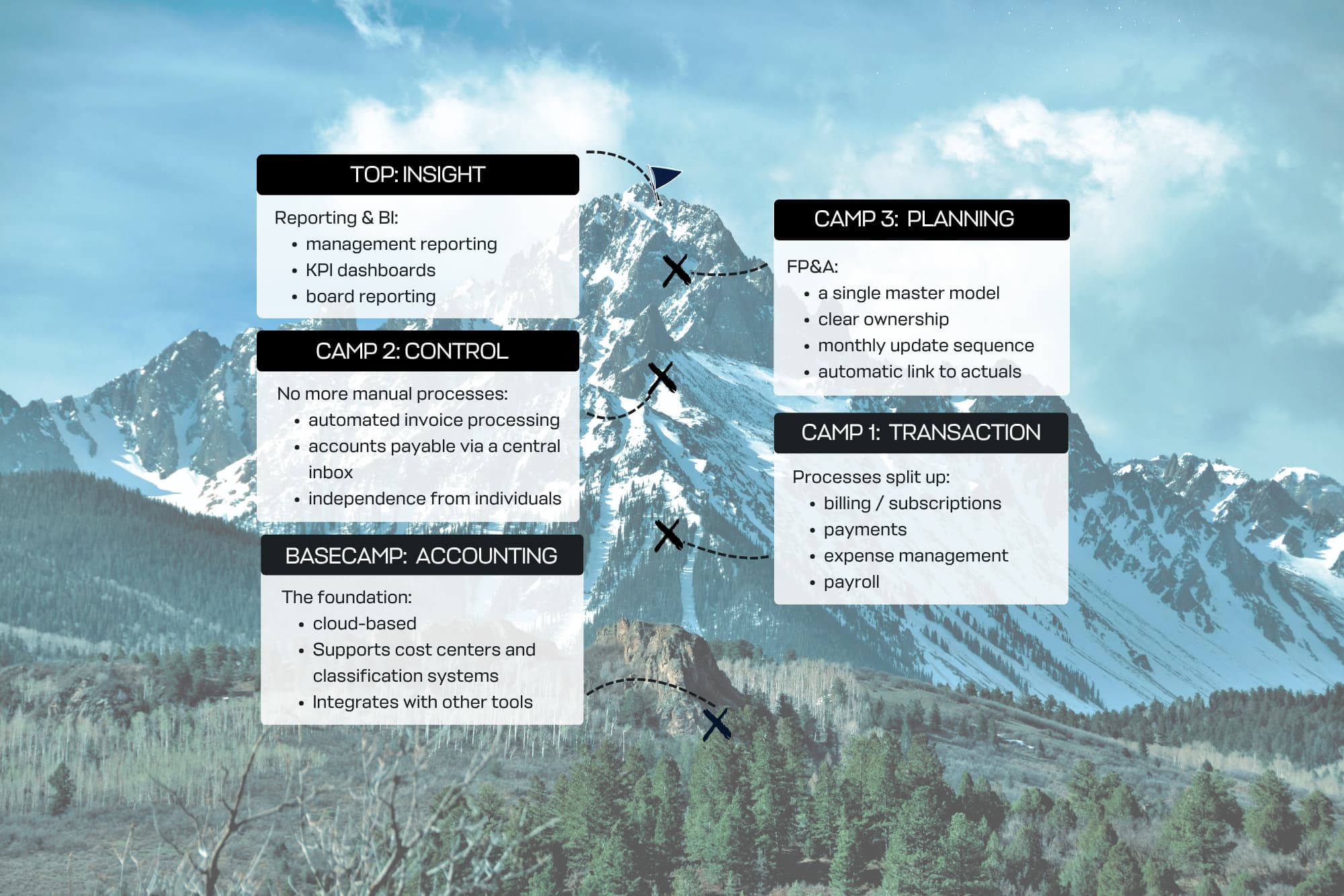
1. Foundation: accounting
Your accounting system is your financial backbone. Everything else feeds into it or out of it. A good solution for a scaling tech company is cloud-based, supports cost center structures, and integrates with other tools without requiring a consultant every time something changes.
If this layer isn't set up properly, everything downstream becomes manual. The most common choices at the venture stage are Exact Online, Xero, and Moneybird, each suited to different stages and levels of complexity.
Match the tool to your company's actual size, transaction volume, and growth trajectory. The right tool for a 10-person startup often isn't the right fit for a 50-person company managing multiple entities.
2. Transaction layer
As complexity increases, the processes branch out. Billing and subscriptions, payments, expense management, payroll. Each of these eventually needs its own structure.
For expense management, integrated tools like MOSS or PLEO remove significant manual overhead. Cards are issued per team or department, expenses are captured via mobile, and everything flows directly into the accounting system. No end-of-month credit card statement reconciliation. No manual reclassification.
For SaaS companies with subscription billing through platforms like Stripe, a direct API integration into your accounting system ensures that every revenue event, upgrade, downgrade, and churn event is correctly and automatically recorded. That same subscription data feeds your MRR reporting and revenue recognition without manual handling.
You don't need everything from day one. But as volumes increase, these systems must reduce manual work, improve data quality, and make reporting more reliable.
3. Control layer
This is where friction most commonly surfaces as companies grow.
Manual invoice processing or accounts payable managed through individual email inboxes. These are financial decisions that depend on one person understanding the system. When that person is on holiday or leaves, the process stops.
By structuring accounts receivable and payable workflows, and implementing clear approval thresholds and payment authorization processes, finance becomes something the organization can operate, not just the individual who built it.
4. Planning layer (FP&A)
Excel is still the most widely used system here for early and mid-stage ventures. And it can work well, provided the setup and surrounding process are professionally organized. One master model, a clear owner, a monthly update sequence, and an automatic link to actuals.
What doesn't work is multiple versions of the model floating across inboxes, assumptions that were last updated six months ago, and no one certain which file is current.
At more mature stages, or when reporting requirements from investors increase, a dedicated FP&A platform adds value by automating the connection between actuals and the forecast. This way scenario analysis is supported and it enables faster board-ready reporting.
5. Insight: reporting and BI
As the business grows, the need for structured insight increases. Management reporting, KPI dashboards and board reporting: these are no longer a quarterly exercise but a continuous operational requirement.
For SaaS companies, this means consistent definitions for metrics like MRR, ARR, gross revenue churn, net revenue retention, and customer acquisition cost. Defined once, applied consistently, and connected to the accounting layer so there's no manual recalculation each month.
More important than the specific reporting tool is the discipline behind it. Clean data, consistent definitions, and alignment between what the finance team reports and what the investor deck says.
Optional: additional layers
Depending on your stage and structure, you may also need equity management tools (particularly relevant once multiple funding rounds and option pools are in play). Or you can expand into SaaS-specific metrics tools that connect to your product and CRM data, or multi-entity accounting setups as international expansion begins.
These layers are worth adding when needed. Not before you have a robust foundation.
How to know your current finance stack isn't working
Check these clear signals:
- Month-end close takes longer than five working days.
- Reporting requires significant manual reclassification of data.
- The same numbers appear differently in different documents.
- One person holds the entire process in their head.
- Preparing for an investor meeting requires building something from scratch each time.
If any of these are true, the stack isn't serving the business anymore.
A good finance stack supports growth without rebuilding it
A good finance stack for a scaling tech company reduces manual work, speeds up reporting, makes data reliable, and removes dependence on individuals. Most importantly, it supports growth without requiring a full rebuild every time the company moves to the next stage.
The stack is designed to scale. The right systems deployed at the right time, with clean integrations and stable processes behind them.
Frequently asked questions about a finance tech stack
What is a finance tech stack?
The collection of software and tools a company uses to manage accounting, reporting, automation, and financial operations. It typically starts with a general ledger and expands as the business grows.
For tech companies specifically, this often includes subscription billing tools, SaaS metrics tracking, and FP&A platforms alongside standard accounting and reporting infrastructure.
What tools should a tech finance team have?
At minimum, a cloud-based general ledger. Exact Online, Xero, and Moneybird are the most common choices at the growth stage. Beyond that, the right additions depend on your business model. SaaS companies typically add subscription billing and revenue recognition tools early.
As analytical demands grow, FP&A tooling, dashboards, and expense management platforms become important. The sequence matters, you have to build the foundation before adding intelligence on top of it.
How do I choose the right accounting software for a SaaS or tech company?
Match the software to your company's actual size, transaction volume, and growth trajectory, not to what's most popular or what a larger company uses. An 8-person SaaS startup with straightforward recurring revenue has different needs than a 60-person company managing multi-currency, multi-entity reporting and investor-grade financial statements.
Consider how well the tool integrates with your billing platform, CRM, and payroll system before committing.
Why is an integrated finance tech stack so important?
Because manual data transfer between disconnected systems is where errors accumulate and time gets lost. When your billing platform, bank data, expense management, and reporting tools are connected, your team stops reconciling discrepancies and starts doing actual analysis.
For SaaS companies, this is particularly important. MRR waterfalls, churn calculations, and cohort analysis require clean, automated data flows, not monthly exports and copy-paste.
When should a tech startup start thinking about its finance stack?
Earlier than most do. The common mistake is building the stack reactively, once reporting requirements from investors or growing transaction volumes make the current setup unworkable.
By that point, a cleanup and rebuild costs significantly more time and money than a well-structured setup from the start.
Our advice? After your first institutional round, review whether your current setup can support the reporting and modelling requirements of the next 18 to 24 months. If it can't, address it then, not six months later when you're preparing for your next raise.
When is it clear your current finance tech stack is suitable?
Your stack is working if your team is spending less time on month-end close, financial reporting, and manual reconciliation and more time on analysis and decision support.
Do a practical test: can someone unfamiliar with your setup step in and run the monthly reporting process without needing to ask multiple people how things work? If not, the stack is carrying too much implicit knowledge and too little structure.
Does a well-structured finance stack help with due diligence?
Significantly. A clean, consistent chart of accounts, automated data flows, and documented processes reduce both the time and the risk associated with financial audits and investor due diligence.
In M&A or fundraising processes, the quality of your financial infrastructure directly affects how quickly a process can move and how much confidence it generates on the other side of the table. Companies that have invested in their finance stack early consistently move through due diligence faster.
What's the most common mistake tech companies make with their finance stack?
Two opposing mistakes appear equally often. The first is staying in a spreadsheet-based setup too long, until fragility forces a crisis rebuild. The second is implementing a complex, expensive system too early, before the volume or complexity justifies it. And then spending significant time managing overhead rather than building the business.
The right approach is modular. Start with a solid foundation and add layers as the business genuinely outgrows each one.
Want financial advice for your tech company?
If you want to explore this topic further and find out what F.INSTITUTE can do for your organization, don't hesitate to get in touch with us. We'd love to discuss your goals!