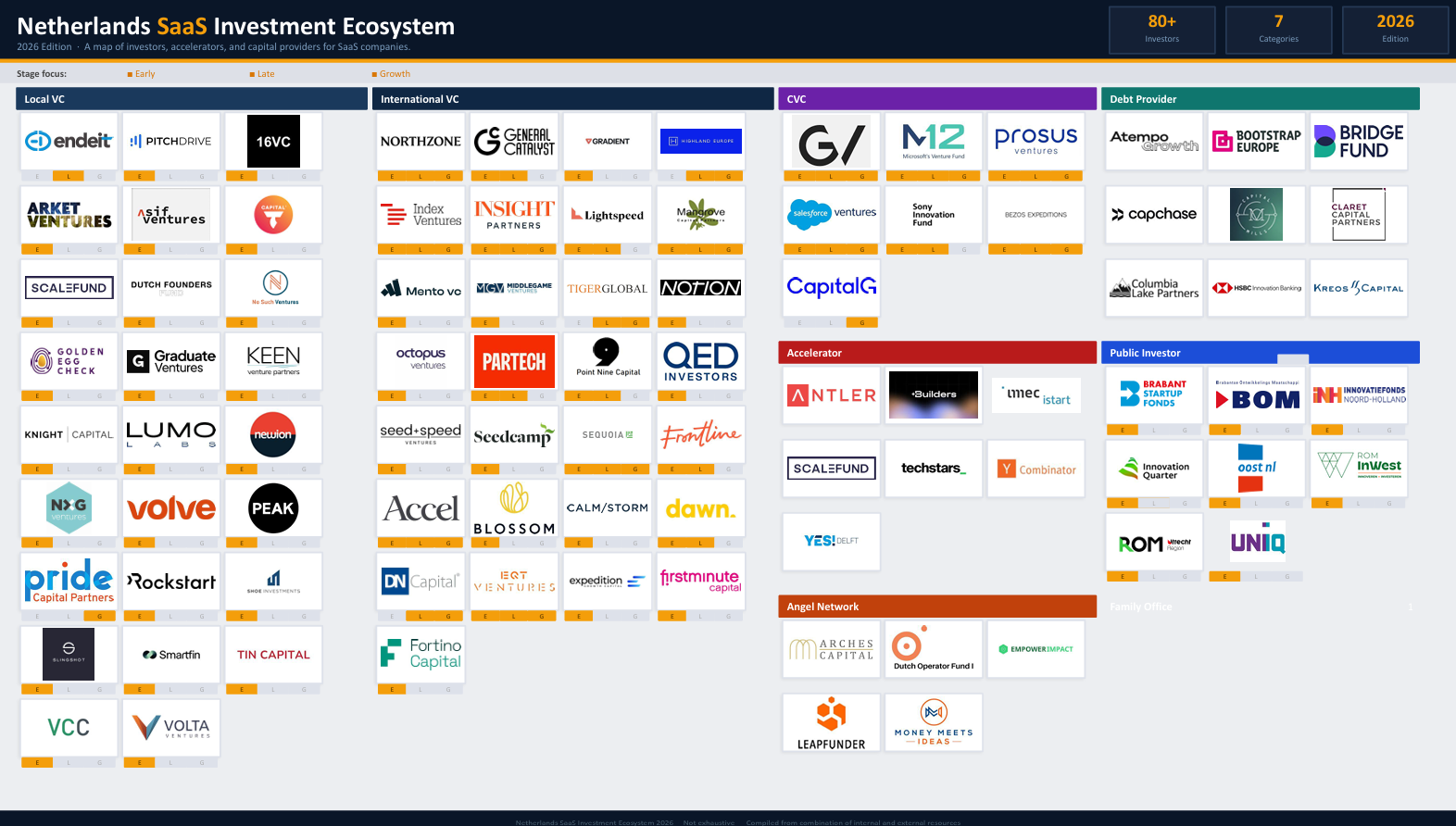
The Right Investor – Focus on funds that align with your stage, industry, investment size, and ambition. Create a targeted long list of 10–15 relevant investors.
Your Team – Be honest about any missing key roles and show how you plan to fill those gaps through hiring, advisors, or fractional expertise.
Market & go-to-market – Demonstrate that you know your ICP, that customers are willing to pay, and that your traction is repeatable. Back this up with customer interviews, funnel data, and a clear pricing rationale.
Pure SaaS Metrics – Ensure that MRR, churn, CAC, LTV, and gross margin are clearly and correctly defined. Consistency between the deck, the model, and your conversations is crucial.
Financial Management – Use accrual-based accounting, correct revenue recognition, clear cost centers, and a well-founded runway with multiple scenarios.
A funding round isn’t a pitch: it’s a period of self-reflection, research, and systematic preparation. And it begins long before you walk into your first meeting with potential investors.
Founders who underestimate this enter the market with gaps in their story because they haven’t thought about what an investor sees when looking inside your business-and what they expect to see.
In this article, we’ll share five practical SaaS funding tips to help you fill those gaps before an investor spots them.
1. How does an investor view your business?
Money is a commodity, but an investor certainly isn’t. Every VC has a mandate: a specific stage, a geographic focus, a sector preference, and minimum and maximum investment amounts.
A fund that invests in Series B rounds of at least €10 million has no operational reason to seriously consider a €1.5 million Seed round. An investor focused on Deep Tech has a different evaluation framework than a fund that focuses purely on SaaS.
Yet most founders approach investors as a homogeneous group. They send a pitch deck to anyone who has ever funded “tech” and wait for a response.
The result is a cycle of back-and-forth: months of conversations, none of which lead to a commitment, with 10 different pieces of feedback that sometimes contradict each other. That’s just noise.
How do you prepare for this?
Ideally, your preparation starts with a long list of 10–15 investors who truly align with your stage, sector, and ambition. For each one, delve into their investment strategy, their recent deals, and their vision for your market. Then tailor your story to what they’re looking for-not the other way around.
2. How does an investor view your team?
No team is ever complete, and investors know that. But there’s a difference between one open position and a pattern of gaps in the roles that matter most.
A strong product without experienced commercial leadership is a risk. A strong CTO without someone to oversee the financial side is as well. Three or four gaps in key positions at once is a reason for many investors to walk away because the risk of execution failure becomes too high.
How do you prepare for this?
Be honest about what’s missing. That may sound like contradictory advice for a pitch, but investors who discover this on their own during due diligence react differently than those who hear it from you.
Identify the gaps and show that you know how to address them: a concrete hiring roadmap, a consultant who can bridge the gap, or a fractional solution for the period you need to grow. Honesty about your team isn’t a weakness-it’s a sign of self-awareness.
3. SaaS funding tips for your market and go-to-market strategy
Market size sets the context for your story. What investors want to understand is whether you truly know your ICP-not as a persona on paper, but as actual purchasing behavior. What pain point are you solving, for whom specifically, and what is that person willing to pay? Is there evidence of willingness to pay, or is it just an assumption?
And then there’s the go-to-market strategy: is there reproducible traction? A predictable funnel, a consistent conversion rate, a pricing model that’s starting to work in the market. Not 10 deals that were each closed differently, but a pattern you can explain and repeat. The latter is what “product-market fit” means in practice.
How do you prepare for this?
Interview your five best customers before entering the market to understand the words they use to describe the problem you’re solving. Document your funnel with concrete conversion rates for each step.
And build a pricing rationale: why does your product cost what it does, who pays that price without hesitation, and who drops out?
4. SaaS Metrics That Investors Evaluate
This is the area where most founders stumble because they don’t clearly define their own metrics.
MRR must be unambiguous. Which revenues count and which don’t? An unpaid pilot included in your MRR or a one-time implementation fee are not MRR.
Churn has three definitions, each telling a different story:
logo churn (the percentage of customers who leave)
gross revenue churn (the revenue that is lost)
net revenue churn (the net result of expansion and loss).
An investor who asks about churn and receives an answer without specifics will ask for more details. So make sure you’ve already answered the question before it’s even asked.
You should only calculate CAC and LTV once marketing and sales costs have been correctly allocated.
And gross margin deserves specific attention: a SaaS company with a gross margin of 100% is reporting its costs incorrectly. Hosting, support, customer success-these belong in COGS. An investor who has to correct this themselves will wonder what else is off.
How do you prepare for this?
Write down the definition you use for each metric before entering a meeting. Then have someone outside the company review your model-a consultant, a CFO friend, or anyone who dares to be critical.
What they don’t understand without an explanation, an investor won’t understand either. And make sure your definition of churn is consistent throughout your reporting: in your pitch deck, your model, and your conversations.
5. Financial Management: What SaaS Investors Check
This is the foundation. Everything mentioned above rests on this. Accrual-based accounting is a requirement for any company seriously raising external capital.
Cash-based accounting gives a distorted picture of when revenue is earned and when costs are incurred. An investor who can’t read your financial statements without first restructuring them will lose confidence.
Revenue recognition must be in order. Annual contracts that are booked all at once in the month they’re signed do not accurately reflect your company’s performance.
How do you prepare for this?
Establish clear cost centers: product, sales, marketing, G&A, and COGS. Not as an accounting formality, but so that you can see for yourself what each euro yields-and so an investor can see it too.
And finally: your runway analysis. Build a base case, a low case, and a high case, with the assumptions for each scenario clearly stated. This shows that you understand the future is uncertain and that you’ve already thought it through.
Bonus: customer references
When an investor has doubts, an enthusiastic customer can be more persuasive than you, the founder, can be.
Prepare five to ten customers who are willing to speak. First, do a dry run call yourself: what do they say, how do they describe the problem you’re solving, and what words do they use? This also gives you insight into how your value proposition is perceived in the market.
SaaS Funding Tips for Proper Preparation
A funding round is an intensive process, but the outcome can largely be influenced. Founders who enter the market well-prepared-with the right investors on their long list, clear metrics, and financials that exude transparency rather than raising questions-raise capital faster and under better terms.
We help founders go through that preparation process if there’s still time to get things in order.
Want financial advice for your tech startup or scaleup?
Would you like to know where your company stands right now from a funding perspective? F.INSTITUTE helps SaaS companies with the financial and operational preparation for financing or an acquisition, from the initial analysis to the data room. Don't hesitate to get in touch with us. We'd love to discuss your goals!